 how-to
How to Remove Rust Stains from Concrete Driveways
Table of Contents
- Why Rust Stains Are So Stubborn on Concrete
- What You'll Need to Remove Rust Stains
- Step-by-Step: How to Remove Rust Stains from Your Concrete Driveway
- Does Vinegar Damage Concrete? What to Know
- Choosing the Best Rust Remover for Concrete
- Preventing Future Rust Stains and Sealing Your Driveway
- When to Call Professional Concrete Stain Removal Services
- Frequently Asked Questions
Last Updated: September 4, 2026
Rust stains on a concrete driveway are notoriously difficult to lift because concrete is porous, so the iron oxide penetrates deep into the aggregate and cement paste. At Steve's Premium Pressure Washing, we've spent over a decade tackling these stains across Central Florida, and the process is more about chemistry and dwell time than elbow grease. Below, we'll show you exactly how to remove rust stains from concrete driveway surfaces, which commercial products actually work, and how to keep them from coming back.
The key distinction most guides miss is that rust removal is a chemical reaction, not a scrubbing contest. You need an acid or chelating agent that dissolves the iron oxide, followed by thorough rinsing to neutralize the surface.
Why Rust Stains Are So Stubborn on Concrete
Rust binds to concrete in a way that makes it uniquely resistant to standard cleaners. The iron oxide particles lodge into the microscopic pores of the slab, and because concrete is alkaline, many common acids get neutralized before they can work. This is why a degreaser or all-purpose cleaner won't touch a rust mark.
The age of the stain matters more than most homeowners realize. Fresh rust lifts quickly, while a stain that has weathered several rainy seasons has oxidized further and penetrated deeper. If the source is still rusting, move it before treating the concrete, or you'll be cleaning the same spot twice.
What You'll Need to Remove Rust Stains
Before starting, gather the right materials and protective gear. Attempting this with the wrong tools wastes time and can permanently etch your driveway.
- Safety goggles and protective gloves (acid-based removers can splash)
- A stiff scrub brush with synthetic bristles
- A garden hose or pressure washer for rinsing
- A pump sprayer or watering can for applying liquid removers
- A commercial rust remover containing oxalic acid or a citrus-based chelating agent
- A concrete sealer for post-cleaning protection
Citric acid and oxalic acid are the two active ingredients that consistently dissolve rust on concrete. Commercial products formulated with these are safer and more predictable than mixing your own. Avoid muriatic acid, which can discolor or etch the concrete surface permanently.
Step-by-Step: How to Remove Rust Stains from Your Concrete Driveway
This process works for driveways, patios, and garage floors. Expect to spend 15 to 30 minutes per stain, depending on severity and dwell time.
Step 1: Identify the Rust Type and Test a Small Area
First, determine whether the stain is surface-level or deep-set. Light brown or orange marks that appeared recently are surface rust. Dark, reddish-brown stains that have been present for months or years have penetrated deeper and will require a longer dwell time.
Always test your chosen remover on an inconspicuous area first. Concrete varies in density and finish, and some removers can lighten or etch the surface. Apply the product to a small patch, wait the recommended time, and rinse thoroughly to confirm there's no adverse reaction before treating the visible stain.
Step 2: Apply Your Rust Remover and Let It Dwell
Apply the rust remover generously so the stain is fully saturated. The chemical reaction needs moisture to work, so don't let the product dry out mid-treatment. Dwell time typically ranges from 5 to 15 minutes for oxalic acid-based gels, while citric acid solutions may need up to 30 minutes on stubborn stains.
For vertical surfaces or hot days when the remover evaporates quickly, reapply as needed to keep the area wet. The stain should visibly lighten or bubble as the acid dissolves the iron oxide. If nothing happens after the full dwell time, the stain may be sealed under grime or oil, which requires a degreaser first.
Step 3: Scrub, Rinse Thoroughly, and Neutralize
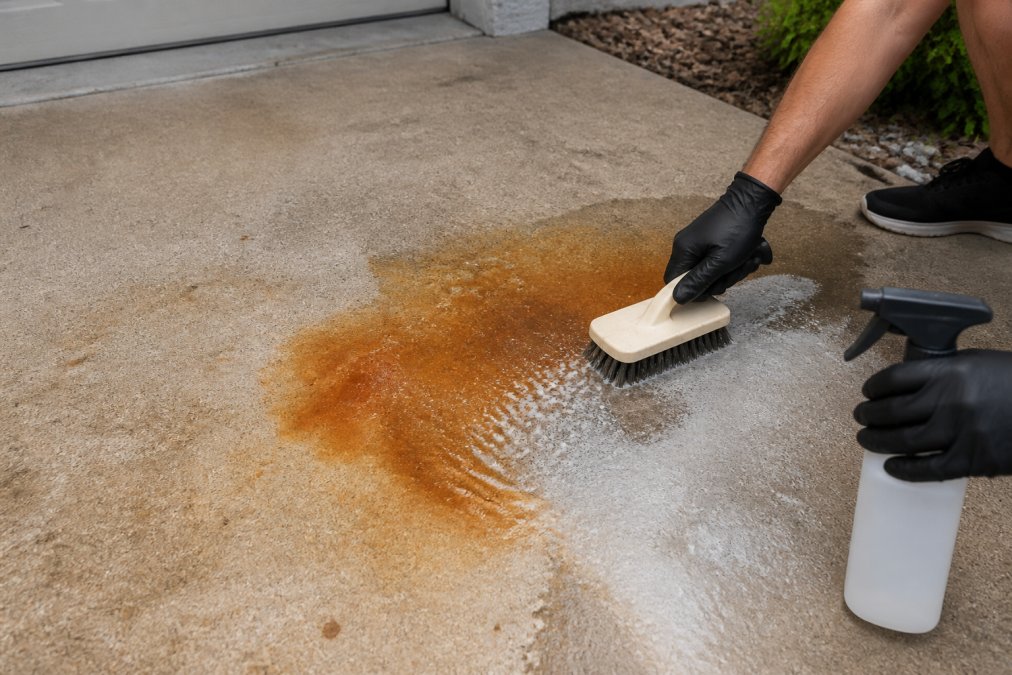
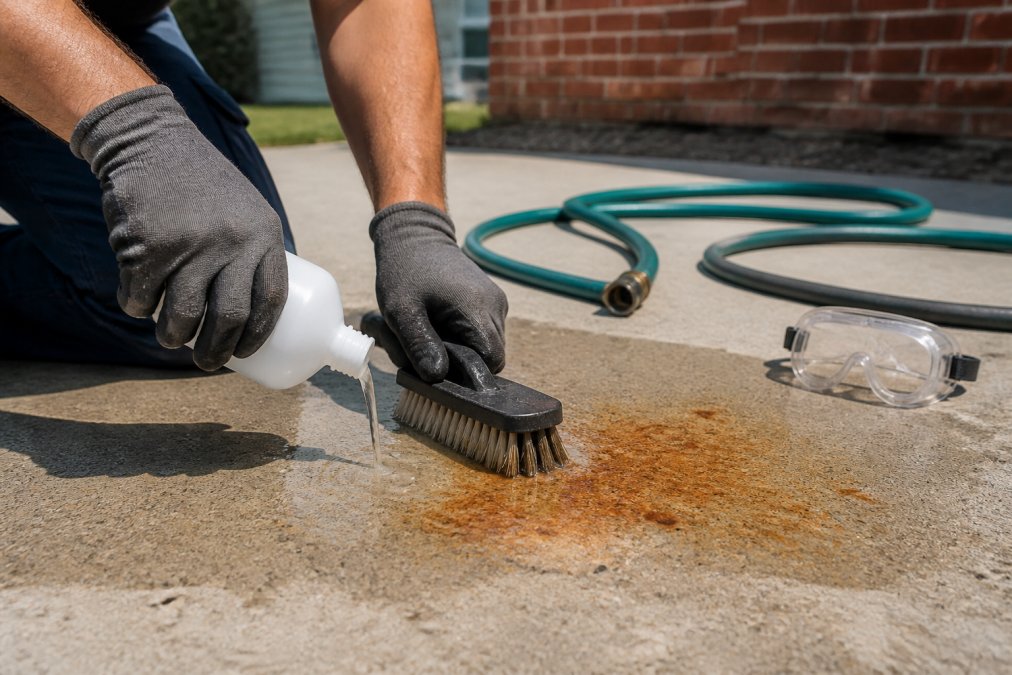
Scrub the treated area with your brush to work the dissolved rust out of the pores. Use firm, circular pressure but avoid aggressive scrubbing that could damage the surface.
Rinse thoroughly with clean water to flush away the dissolved iron and any residual acid. Leftover acid can continue eating at the concrete or leave a chalky residue. If you used a strong acid-based remover, follow the manufacturer's instructions for neutralizing, which often involves a baking soda and water solution applied before the final rinse. Repeat the entire process if a shadow of the stain remains after the concrete dries completely.
Does Vinegar Damage Concrete? What to Know
Vinegar is one of the most frequently recommended DIY rust removers online, but its performance on concrete is more nuanced than most advice suggests. The active ingredient in white vinegar is acetic acid, typically at a 4% to 7% concentration (the FDA). Acetic acid does dissolve iron oxide, which is why vinegar can lift a light, fresh rust mark. However, concrete is an alkaline material. When acetic acid meets these compounds, it triggers a neutralization reaction that consumes the acid before it can do sustained work on the rust, which is why vinegar often appears to work initially but leaves a stubborn shadow behind.
The bigger risk is surface etching. The same reaction that neutralizes the acid also dissolves the cement paste that binds the aggregate together. On a weathered driveway, the surface is already slightly porous, and vinegar accelerates that breakdown. A common pattern is a dull, lighter-colored patch that feels rougher and traps dirt more readily. This etching is usually invisible while the surface is wet, so homeowners often don't notice the damage until the concrete dries completely.
There is also a concentration problem. Most rust removers formulated for concrete use oxalic acid at 5% to 10% or citric acid at 10% to 20% concentration, both significantly stronger than the acetic acid in vinegar. Even at those higher concentrations, oxalic and citric acids are chosen because they chelate iron ions rather than simply dissolving them. Chelation pulls the iron out of the concrete's pore structure, whereas vinegar's weak acid only attacks what is directly on the surface. This is why vinegar fails on the deep-set stains typical of driveways.
If you are determined to try vinegar, there is a safer approach. Use distilled white vinegar at full strength, apply it only to the stain, and set a maximum dwell time of 10 minutes. Scrub gently with a nylon brush, then rinse thoroughly with a baking soda solution (one cup of baking soda per gallon of water) to neutralize any residual acid. This method can work on a stain that is less than a week old and confined to the top surface. For anything older or darker, you will save time by going straight to a product designed for the job.
One additional consideration is that vinegar's etching effect is not always negative. On a heavily stained, weathered driveway that you plan to reseal anyway, a mild etch can actually improve sealer adhesion. But this is an advanced technique, not a reliable rust removal method. For the vast majority of homeowners, vinegar is a passable cleaner for light surface oxidation on smooth concrete, but it is the wrong tool for rust stains that have penetrated the surface, and it carries a real risk of permanent cosmetic damage.
Choosing the Best Rust Remover for Concrete
The rust remover market for concrete breaks down into three distinct product categories, and each one has a specific role.
Oxalic acid-based removers are the industry standard for concrete. Oxalic acid works through a double mechanism: it dissolves iron oxide and then chelates the freed iron ions, preventing them from re-depositing on the surface. Products typically come as a crystalline powder you mix with water, such as Zud or Bar Keepers Friend, or as a pre-mixed gel. The powder form is more economical for large driveways, running about $12 to $18 for a container that makes several gallons of solution. The gel form, like Rust-Oleum's Concrete and Garage Floor Rust Remover, costs $15 to $25 per quart but clings to vertical surfaces and porous concrete more effectively, which extends dwell time. Oxalic acid is the right choice for medium to heavy stains. The main drawback is that oxalic acid is toxic if ingested and can irritate skin, so gloves and eye protection are non-negotiable.
Citric acid-based removers are the eco-friendly alternative. Citric acid is a weaker acid than oxalic, but it is a more effective chelating agent at neutral pH. This means it can pull rust out of the concrete's pores without aggressively attacking the cement binder. Products like CitriStrip or generic citrus-based concrete cleaners are biodegradable and safe around landscaping. The trade-off is speed and strength. Citric acid typically requires a 20 to 30 minute dwell time on light stains and may need multiple applications on anything beyond surface oxidation. Prices range from $10 to $20 per quart. For a homeowner treating a small stain near plants or with pets that roam the driveway, citric acid is the safer bet.
Phosphoric acid-based removers occupy a middle ground. Phosphoric acid dissolves rust effectively and leaves behind an iron phosphate layer that actually passivates the surface, slowing future rust formation. Products like Naval Jelly are common in this category. However, phosphoric acid can leave a white residue on concrete if not rinsed thoroughly, and it is less effective on deep-set stains because it does not penetrate as well as oxalic acid. It is a reasonable choice for fresh, surface-level rust, but not the best tool for the years-old stains that most driveways accumulate.
What about muriatic acid? Avoid it entirely. Muriatic acid is hydrochloric acid, and while it will dissolve rust, it also dissolves the calcium hydroxide in concrete at a much faster rate (the NIH). The result is a pitted, discolored surface that looks worse than the original stain. Even professional contractors rarely use it on concrete for rust removal.
A unique angle that most guides miss is the interaction between your remover and your local water chemistry. If you are on well water or municipal water with high iron content, the rinse water itself can leave new rust deposits as it dries. In this situation, use distilled water for the final rinse, or plan to apply a chelating rinse aid after the main treatment. This explains why some homeowners report that stains reappear within days of cleaning even though the original rust was fully removed.
Finally, match the product to your application method. Liquid removers work best with a pump sprayer for large areas, but they run off vertical surfaces and evaporate quickly on hot days. Gel removers stay where you put them, making them ideal for isolated stains. For a whole-driveway treatment, a powder you mix yourself and apply with a watering can is the most cost-effective approach. Check the label for the active ingredient concentration: products with 5% to 10% oxalic acid are suitable for most residential stains, while commercial-grade products at 20% or higher are overkill and increase the risk of surface damage without speeding up the reaction.
Preventing Future Rust Stains and Sealing Your Driveway
The most effective way to prevent rust stains is to stop metal from sitting directly on the concrete. Use plastic or rubber pads under metal patio furniture, planters, and tools, and move vehicles that drip water from rusty undercarriages. Address any metal that's actively corroding before it stains the slab again.
After the rust is removed and the concrete is fully dry, apply a penetrating concrete sealer. A good sealer fills the microscopic pores that trap iron oxide, giving you a window of time to wipe up spills and rust before they set. It also makes future cleaning easier. Reapply the sealer every two to three years, or as recommended by the manufacturer, to maintain the barrier.
Regular maintenance also helps. Sweep the driveway weekly to remove metal shavings and debris, and rinse away leaf litter that holds moisture against metal objects. A quick rinse with a hose after rainy periods prevents the prolonged dampness that accelerates rust formation.
When to Call Professional Concrete Stain Removal Services
Some rust stains resist every DIY attempt. If you've treated the stain twice with a quality remover and it hasn't budged, the iron may have penetrated exceptionally deep or bonded with minerals in the aggregate. In this scenario, professional concrete stain removal services have access to industrial-grade acids and pressure washing equipment that can lift deposits homeowners can't.
Professional services also make sense for large driveways with multiple stains or when you're preparing a home for sale and need the entire slab to look uniform. The cost of buying multiple commercial removers and spending a full weekend scrubbing often exceeds the price of hiring a crew with the right tools and experience.
When choosing a provider, ask about their approach to chemical safety and environmental impact. A reputable company will neutralize runoff, protect nearby landscaping, and use soft wash techniques that clean without etching the concrete. At Steve's Premium Pressure Washing, our team uses professional-grade equipment and advanced techniques to restore driveways to spotless condition, with transparent upfront pricing and no hidden fees.
Rust stains are one of the toughest driveway problems to solve, but the right chemistry and technique make them manageable. Start with a targeted remover, respect the dwell time, and always seal the concrete afterward to prevent a repeat performance. When a stain has penetrated too deep for DIY methods, professional concrete stain removal services are the reliable path to a clean, uniform surface. Get an estimate from Steve's Premium Pressure Washing and let our team restore your driveway with the personalized, spotless results your property deserves.
Frequently Asked Questions
Will rust stains come out of concrete?
Yes, most rust stains on concrete driveways can be removed. The key is using the right remover for the stain's age and depth. Fresh stains lift with a simple scrub and mild acid. Older, deep-set stains that have penetrated the porous surface may need a commercial rust remover with a longer dwell time, or professional equipment. In severe cases where rust has soaked deep into the concrete, professional concrete stain removal services may be the most effective option.
Does vinegar damage concrete?
Vinegar is acidic enough to etch or dull the surface of concrete, especially on newer pours or unsealed driveways. While it can dissolve surface oxidation, its acid can break down the cement paste that holds the aggregate together. For occasional spot cleaning of small rust marks, diluted vinegar is a low-risk option. For larger stains, a dedicated rust remover formulated for concrete is safer for the material and more effective on the stain.
Can pressure washing remove deep-set rust stains?
Pressure washing alone rarely removes deep-set rust stains. The water pressure cleans surface dirt and grime but does not dissolve the iron oxide that has penetrated the concrete's porous surface. To remove deep stains, a chemical rust remover must be applied first to dissolve the stain, then rinsed thoroughly. Using a pressure washer after a chemical treatment can help lift the dissolved residue, but the chemical is doing the actual removal work.
What is the best professional-grade cleaner for concrete rust?
Professional-grade rust removers for concrete typically use oxalic acid or a specialized chelating agent that targets iron oxide without damaging the concrete. These products are stronger than household options and work faster on old or stubborn stains. Look for a bleach-free formula with a rust inhibitor. Always test in an inconspicuous area first, follow the label's dwell time, and wear safety goggles and protective gloves. A professional service can also apply these products with commercial equipment for optimal results.